Prescription for Prosperity 2026: Briefing to the Incoming Government
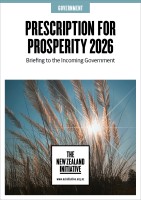
This is The New Zealand Initiative’s 2026 Prescription for Prosperity. Since 2017, the Initiative has prepared a briefing for the incoming government. Read more
The New Zealand Initiative is committed to a better New Zealand for all New Zealanders. That means a country that is both prosperous and able to live within its environmental limits.
Too often, economic development is seen as being at odds with environmental sustainability. Long term economic development cannot undermine New Zealand’s environmental capital; growth based on eroding our shared environment cannot be sustained.
Solutions to environmental problems must also be economically sustainable. Finding the most cost-effective ways of improving environmental quality is critical if we want to do the most we can to maintain and improve the environment.
Climate policy has been an area we have championed. A few years ago, The New Zealand Initiative was a lonely voice emphasising the importance of the Emissions Trading Scheme as the best tool to cut emissions. We have warned against introducing other, often expensive, policies that are incompatible with our world-leading cap-and-trade system.
Our work in this area has gained support among politicians and organisations such as BusinessNZ and the Taxpayers’ Union, as Kiwis begin to question climate policies that purport to reduce emissions, but cannot do so under the ETS cap.
Our work in fisheries management pointed to collaborative solutions respecting both the quota rights of commercial fishers and Kiwis’ birth right to a sustainable recreational fishery.
Our ongoing work in water management looks to cap-and-trade solutions that encourage those able to reduce the burden on each water catchment to do so, while respecting the long-established water drawing rights of those with current consents and recognising iwi claims to water. And our work in electricity generation suggests ways of working with the electricity market to make the most effective transition to a more renewable future rather than relying on regulatory imperatives that cost more while doing less.
New Zealanders deserve a pristine and prosperous country. We can have both.
Featured Publication
This is The New Zealand Initiative’s 2026 Prescription for Prosperity. Since 2017, the Initiative has prepared a briefing for the incoming government. Read more
This submission in response to the Severe Weather Emergency Recovery Legislation Bill is made by The New Zealand Initiative (the Initiative), a Wellington-based think tank supported primarily by major New Zealand businesses. Read more
This submission in response to the Natural and Built Environment Bill is made by The New Zealand Initiative, a Wellington-based think tank supported primarily by major New Zealand businesses. The Initiative has been deeply concerned about resource management policy and practice since its establishment in 2012. Read more
This supplementary submission in response to the Emissions Reduction Plan is made by The New Zealand Initiative (the Initiative), a Wellington-based think tank supported primarily by major New Zealand businesses. It should be read in conjunction with our initial submission of 27 June 2022. Read more
This submission on the Smokefree Environments and Regulated Products (Smoked Tobacco) Amendment Bill is made by the New Zealand Initiative and the Reason Foundation, a non-profit U.S.-based think-tank. The Reason Foundation’s nonpartisan public policy research promotes choice, competition, and a dynamic market economy as the foundation for human dignity and progress. Read more
Wellington (Wednesday, 27 May 2026) – New Zealand can be a much more prosperous country, and the policy choices needed to get us there are well within reach, says The New Zealand Initiative’s Executive Director, Dr Oliver Hartwich. The Initiative today released Prescription for Prosperity 2026, its fourth briefing to an incoming government. Read more
The United Nations Environmental Programme’s latest Emissions Gap Report was called “No more hot air … please!” Yesterday, I joined a panel at the Climate Change & Business Conference to talk about New Zealand’s Nationally Determined Contribution – our NDC. Under the Paris Agreement, countries must produce targets for emission reductions, set policies consistent with their targets, and report on their progress. Read more
Imagine that you owned a vacant piece of land. You were trying to decide whether to put solar panels on it to generate electricity or to plant trees on it to sequester carbon and earn carbon credits. Read more
Getting from Auckland to Cathedral Cove means a two-and-a-half-hour drive over 178 kilometres, the last third of which is a windy path through the Coromandel. Inland Revenue sets a $1.04 per kilometre mileage rate for business travel – a figure meant to include wear and tear on your vehicle as well as running costs. Read more
Our Chief Economist Dr Eric Crampton talk to Jack Tame on Q + A about the ETS and the complexities of carbon pricing, emissions reduction strategies, and the balancing act between environmental and economic considerations in New Zealand's climate policy.
Read more