Prescription for Prosperity 2026: Briefing to the Incoming Government
This is The New Zealand Initiative’s 2026 Prescription for Prosperity. Since 2017, the Initiative has prepared a briefing for the incoming government. Read more
You searched Publications for "" and got 29 results
This is The New Zealand Initiative’s 2026 Prescription for Prosperity. Since 2017, the Initiative has prepared a briefing for the incoming government. Read more
This research note reveals how adding GP clinic data to government databases could transform healthcare outcomes while cutting costs. The research note, “Better health through better data” by Adjunct Fellow Dr Prabani Wood, shows that while government can track hospital visits, prescriptions and even school attendance, it cannot see clearly what happens in GP clinics – where most healthcare occurs. Read more
1. INTRODUCTION AND SUMMARY 1.1 This submission on the Medicines Amendment Bill is made by The New Zealand Initiative (the Initiative), a Wellington-based think tank supported primarily by major New Zealand businesses. Read more
This report highlights the economic benefits of investing in general practice, finding significant potential to ease pressure on hospitals and improve patient care. The Heart of Healthcare: Renewing New Zealand's Primary Care System examines the economic case for strengthening GP services, as Health Minister Simeon Brown recently announced initiatives to address GP shortages. Read more
Canada’s devolution of health services to First Nations provides a strikingly different way of thinking about localism, according to Dr Eric Crampton, Chief Economist with the New Zealand Initiative. “Canada’s central government has long provided, under treaty, a ‘medicine chest’ of funded services to First Nations peoples. Read more
1.1 This submission on the Misuse of Drugs (Pseudoephedrine) Amendment Bill[1] is made by The New Zealand Initiative (the Initiative), a Wellington-based think tank supported primarily by major New Zealand businesses. In combination, our members employ more than 150,000 people. Read more
Requiring Medsafe approval for pharmaceuticals already approved by at least two trustworthy overseas regulators makes little sense. Foreign pharmaceutical approval agencies are well-resourced. Read more
As the nation prepares to vote on 14 October, the sentiment across New Zealand is one of frustration and concern. Skyrocketing living costs, unaffordable housing, strained healthcare, and a growing educational gap are the voices of a country looking for change. Read more
New Zealand's general medical practitioners (GPs) are facing a crisis, with a workforce shortage set to worsen over the next decade unless immediate action is taken to support workforce expansion and development. The health of all New Zealanders and the delivery of top-tier healthcare heavily relies on community-based medical care, mainly provided by Specialist GPs and multi-disciplinary health care teams. The introduction of an "accountability-free capitation" has seemingly driven a decline in the hours GPs work by creating a financial incentive to minimize patient service costs, and analyses indicate a significant decrease in the GP to population ratio, and a decline in GP work hours. Read more
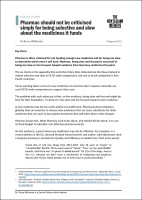
Pharmac is often criticised for not funding enough new medicines and for being too slow to determine which ones it will fund. However, being slow and focused is not proof of being too slow or too focused. Read more