Oregon

Status: Legal History: 1973: Oregon decriminalised possession of small amounts of cannabis to a fine 1998: Oregon legalises medical cannabis 2015: Oregon legalises cannabis for recreational use 2017: Licensed sales begin Consumers: Must be 21-years-of-age or older to purchase, possess or consume cannabis; Can possess up to 8oz (226g) of usable cannabis (dried leaves and flowers), 1oz (30g) of cannabis concentrate, 16oz (453g) of a cannabinoid product in solid form, 72oz (2kgs) of cannabinoid produce in liquid form, 10 cannabis seeds, and four cannabis plants; An individual 21-years-of-age or older can gift cannabis products to another adult so long as it falls within the personal possession limit; May not drive while under the influence of cannabis; May not consume cannabis in public spaces; 17% sales tax on all cannabis-containing products; Possession of more than 1lb (16oz) is a misdemeanour punishable by up to a year in prison and fines of up to $US6250; Unlicensed manufacturing is a felony punishable by up to 20 years in prison and fines of up to $US375,000. Outcomes 10% decrease in violent crime; Counts of marijuana-related calls to the Oregon Poison Center increased across all age groups from 2014 to 2018, with the largest increase among those aged 21 years and older; 13% drop in the murder rate; In 2017, more than half (57%) of adults reported to have used marijuana and 19% reported to use marijuana in the past 30 days; In 2018, 8% of Oregon 8th graders and 20% of Oregon 11th graders reported current marijuana use in the past 30 days; Since 2014, current marijuana use has increased among all age groups; In 2019, tax revenue generated from marijuana totalled $US102.1 million; Increased cannabis-related calls to poison centre; $US70 million in state revenue; $US250 million in sales; In 2017, 57% of Oregon residents report current use of cannabis (used in the past 30 days), 39% of which report daily usage; Between 2005 and 2017, cannabis use disorder in people over the age of 12 increased from 1.9% to 2.4%. Read more

1 December, 2019

Pennsylvania

Status: Medical Use History: 2015: Municipal reforms begin (decriminalisation in some cities and regions) 2016: Medical cannabis legalised Policy Framework: Patients must have a qualifying condition (there are 23 listed); Patients must be certified by a doctor and register to the programme to obtain medical cannabis legally; 30-day supply as prescribed by a doctor; No allowance made for patients to cultivate their own cannabis at home; Pennsylvania can have up to 25 licensed medical cannabis growers and up to 50 dispensaries; Medical cannabis can only be obtained from a dispensary; There are an estimated 116,000 registered medical cannabis patients in Pennsylvania, according to the Pennsylvania Department of Health; Possession of less than 30g (1oz) of cannabis for recreational use is a misdemeanour punishable by up to 30 days in prison and a fine of up to $US500; Possession of over 30g of recreational cannabis is a misdemeanour punishable by up to a year in prison and fines of up to $US5000; Sale or distribution of less than 30g of cannabis without remuneration is a misdemeanour punishable by up to 30 days in prison and fines of up to $US500; Sale or distribution of more than 30g of cannabis is a felony punishable by up to five years in prison and fines of up to $US15,000; Cultivation of any number of plants is a felony punishable by up to five years in prison and fines of up to $US15,000. Outcomes: Between 2005 and 2017, cannabis use disorder in people over the age of 12 decreased from 1.5% to 1.4%. Read more

1 December, 2019

Rhode Island

Status: Medical Use History: 2006: Medical cannabis was legalised 2009: Dispensary system for medical cannabis implemented and sales begin Policy Framework: Patients must have a qualifying condition, of which there are 14 listed; Patients may possess no more than 2.5oz (70g); Patients can cultivate up to 12 plants and 12 seedlings in their homes; No more than nine state-licensed dispensaries are allowed to operate in Rhode Island at a time; There are an estimated 18,728 registered medical cannabis patients in Rhode Island, according to the Rhode Island Department of Health; Possession of less than 1oz (30g) of cannabis for personal recreational use is decriminalised to a civil infraction (like a speeding ticket) punishable by a $US150 fine; Possession of less than a kg of cannabis is a misdemeanour punishable by a year in prison and fines of up to $US500; Possession with intent to distribute is a felony punishable by up to life in prison and fines of up to $US500,000; Cultivation or sale is a felony punishable by up to life in prison and fines of up to $US500,000. Outcomes: Between 2005 and 2017, cannabis use disorder in people over the age of 12 decreased from 2.6% to 2.5%; In 2018, sales of medical marijuana reached $US60.2 million. Read more

1 December, 2019

South Carolina

Status: Prohibited History: 2014: Legalisation of CBD (cannabidiol) oil - children with severe epilepsy can be treated with CBD oil if recommended by a doctor Policy Framework: Possession of less than 1oz (30g) of cannabis for a first-time offender is a misdemeanour punishable by 30 days in prison and a fine of $US200; Possession of less than 1oz of cannabis for a subsequent offence is a misdemeanour punishable by a year in prison and a fine of up to $US2000; Sale or trafficking is a felony punishable by sometimes more than 25 years in prison and fines of up to $US200,000; Cultivation of cannabis is a felony punishable by more than 25 years in prison and fines of up to $US200,000. Outcomes: Between 2005 and 2017, cannabis use disorder in people over the age of 12 decreased from 1.7% to 1.4%. Read more

1 December, 2019
Australia brick3

One-up Australia

This week, opposition leader Simon Bridges announced he would introduce an elite anti-gang task force if elected. Loosely modelled on Australia’s Strike Force Raptor, such a policy may be appropriate on the other side of the ditch. Read more

Insights Newsletter
29 November, 2019
Submission cover18

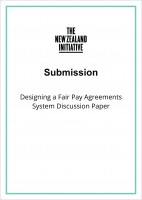
Submission: Designing a Fair Pay Agreements System Discussion Paper

This submission is in response to the Ministry for Business, Innovation and Employment's (MBIE) Discussion Paper, Designing a Fair Pay Agreements System. In making this submission, the authors have drawn on the research and recommendations in our July 2019 report, Work in Progress: Why Fair Pay Agreements would be bad for labour, and say despite the overwhelming evidence against FPAs, if the government nevertheless introduces a framework permitting FPAs, and if the FPAs are to have any legitimacy, they must: be introduced incrementally, targeting only industries where there is evidence of labour markets failing workers and employers. Read more

Roger Partridge
Dr Bryce Wilkinson ONZM
Submission
26 November, 2019

Media Release: Fair Pay proposals too flawed to proceed

The Government must halt its plans to introduce fair pay agreements or face harming workers, consumers, the unemployed and the wider economy says public policy think tank, The New Zealand Initiative. The Initiative’s submission in response to the Ministry of Business, Innovation & Employment’s October 2019 Discussion Paper reveals that the premises on which the fair pay agreement proposals are based remain deeply flawed. Read more

Media release
26 November, 2019
big ben and flag2

Three cheers for no applause

“If you’re happy and you know it, clap your hands”. Clapping is a common gesture across all cultures – even babies clap. Read more

Insights Newsletter
22 November, 2019
learning

Ignorance is not bliss, even in Bluff

“For a child in Bluff who might be interested in muttonbirds, they are not going to be interested in the fact that there are seven continents in the world." This statement, made by the elected President of the New Zealand Principals’ Federation, Whetu Cormick, perfectly encapsulates what is wrong with education in New Zealand. Reported in the Herald in response to a question about our national curriculum, Cormick’s example was prompted by our latest research note Ignorance is not bliss. Read more

Briar Lipson
Insights Newsletter
22 November, 2019

Stay in the loop: Subscribe to updates