The eleventh draft
In a meeting room on Lambton Quay, a paper is on its eleventh draft. It is about whether the public service should adopt AI. Read more
For forty years, New Zealanders have been told that fewer councils mean better government, and for forty years, the evidence has refused to oblige. Until 1989, New Zealand had around 850 elected local government bodies. Read more
When I read last week that Tony Blair had published a 5,600-word essay on everything that ails Britain, every instinct told me not to read it. But I could not help myself and read it anyway. Read more
The debate about New Zealand’s Supreme Court has been framed as a question about the current court – its composition, its appointments, its judicial philosophy. This column frames it differently: as a question about what the current court inherited, and from whom. Read more
This week’s Budget confirmed what most New Zealanders already suspected. The government’s finances are tight, the deficit persists, and there is no pot of money waiting to be spent on the country’s problems. Just as well, because government spending never delivers growth or prosperity. Read more
If the country sees a few lucky breaks, Budget 2026 shows a return to surplus in 2029. The period of structural deficits will have lasted almost a decade. Read more
In this episode, Oliver talks with Eric about Budget 2026, which brings the forecast surplus forward a year but rests on a series of lucky breaks, from oil prices falling to fiscal discipline surviving the election and coalition negotiations. They weigh what is driving spending well above 2019 levels, the case for superannuation reform, council incentives to go for growth, the shrinking public service, and why Treasury's tobacco and alcohol excise forecasts keep going wrong. Read more
In an age of unprecedented technological upheaval — an upheaval more consequential than even the advent of fire or settled agriculture — we find ourselves standing — quite literally — at a crossroads. The question isn't whether AI will transform writing — it’s what we lose when we let it. Read more
Wellington (Thursday, 28 May 2026) – The New Zealand Initiative welcomes the Going for Housing Growth Incentive Fund announced in Budget 2026. The Initiative has argued for more than a decade that councils need a direct financial stake in enabling new housing. Read more
The worst-kept secret of this afternoon’s budget is that the entitlement to a fees-free year of tertiary study will be scrapped. On 8 May, New Zealand First leader Winston Peters ‘leaked’ the policy change on Newstalk ZB. Read more
1. INTRODUCTION 1.1 The New Zealand Initiative (the Initiative) welcomes the opportunity to submit on the Modern Slavery Bill. Read more
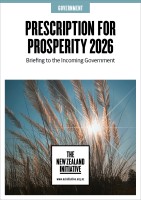
Wellington (Wednesday, 27 May 2026) – New Zealand can be a much more prosperous country, and the policy choices needed to get us there are well within reach, says The New Zealand Initiative’s Executive Director, Dr Oliver Hartwich. The Initiative today released Prescription for Prosperity 2026, its fourth briefing to an incoming government. Read more
This is The New Zealand Initiative’s 2026 Prescription for Prosperity. Since 2017, the Initiative has prepared a briefing for the incoming government. Read more
Last year, Cabinet papers promised that New Zealand’s agricultural-product regulator would be required to use assessments from trusted overseas regulators. The Bills now before Parliament instead say the regulator must merely “have regard to” them. Read more
In this episode, Eric talks with Dr Benno Blaschke and Chris Parker about why our current approach to housing supply, which is focused on housing targets and delivered through “predict and provide”, has consistently failed. The explore what a better system could look like by discussing Benno's proposed alternative, where an independent panel would use price-based indicators to evaluate council plans against the conditions of competitive urban land markets. Read more