
Bad stats are hard to kill
It is the hope that this time it will be different that really kills you. Sisyphus at least knew his labours were futile and could resign himself to the task of forever pushing the boulder uphill. Read more
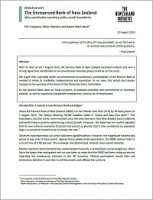
This submission is in response to the second round of consultation on Phase 2 of the Reserve Bank of New Zealand Act review. Written by Roger Partridge and Dr Bryce Wilkinson, this submission focuses on four issues raised in consultation documents 2A and 2B, namely: What high-level financial policy objectives should the Reserve Bank have? Read more
Few parents would give their child a cough medicine that had not been trialled. The potential risks of doing so are endless. Read more
For someone with a hammer, everything looks like a nail, they say. For politicians, large-scale restructuring and reorganisations are sometimes that hammer. Read more
As Doctor Frankenfurter prepared to step up the reactor power input three more points and bring life to the Rocky Horror in the classic Rocky Horror Picture Show, he welcomed the assembled “unconventional conventionists” who would witness his triumph. Unconventional monetary policy is a bit like Doctor Frankenfurter’s giant defibrillator experiment with the Rocky Horror. Read more
With its rate cut on 7 August 2019, the Reserve Bank of New Zealand surprised markets and sent a strong signal that unorthodox or unconventional monetary policy could be on the cards. We argue that, especially under unconventional circumstances, predictability of the Reserve Bank is needed to retain its credibility, independence and reputation. Read more
Following the larger than anticipated cut in the cash rate, the Reserve Bank of New Zealand has signalled its preparation for unconventional monetary policies such as negative interest rates and quantitative easing. But such a move requires an urgent clarification of the Remit given to the RBNZ’s Monetary Policy Committee, argues a new research note by The New Zealand Initiative. Read more
What would happen if New Zealand banks implemented negative interest rates? Executive Director Dr Oliver Hartwich discusses his concerns on TVNZ Breakfast following the Reserve Bank's move of cutting the OCR to 1%. Read more
When US President John F. Kennedy approved the Bay of Pigs invasion in 1961, he relied on advice from his staff, the defence force and the secret service. Read more
These are strange times, even for economists. Fearmongers are urging governments to pump up their spending in order to maintain economic activity. Read more
They say you should never let a good crisis go to waste. New Zealand’s employment figures currently look superb. Read more
Eighties glam-metal band Cinderella taught us we don't know what we've got until it's gone. But it can be harder to know what you could have had if you never had it at all. Read more
Earlier this week the Reserve Bank dropped the official cash rate by 50 base points to one percent - citing slow GDP growth over the past year and declining international trade. But what does this actually mean? Read more
Alan Duff’s latest book – A Conversation with My Country: Where we have come from. Where we can go. Read more
After spending the past half a year watching the Brexit drama unfold, it’s easy to forget another Euro crisis is still simmering: that of Europe’s monetary union. For many years, starting with Greece’s sovereign debt crisis in late 2009, the Euro crisis was a staple of our daily news consumption. Read more