An Open Society Requires Constant Vigilance
Who is responsible for defending liberal democracy when its norms come under attack? Karl Popper, writing as fascist armies swept Europe, understood this was not an abstract question. Read more
In this episode, Oliver talks to Stephen Crosswell, a partner at Baker McKenzie in Hong Kong, the world’s strongest law firm brand. He is chair of the firm’s Asia-Pacific Antitrust & Competition Group and one of Hong Kong’s leading trial lawyers, admitted to practise in five countries. Read more
The United Nations Environmental Programme’s latest Emissions Gap Report was called “No more hot air … please!” Yesterday, I joined a panel at the Climate Change & Business Conference to talk about New Zealand’s Nationally Determined Contribution – our NDC. Under the Paris Agreement, countries must produce targets for emission reductions, set policies consistent with their targets, and report on their progress. Read more
Tell someone in an Auckland café that the economy is booming and they will laugh. Unemployment in the city is 6.1 per cent. Read more
In November 2023, National, Act, and New Zealand First announced the coalition agreements that formed their government. One item stood out, at least for me. Read more
When housing policy is split among more than six ministers, who is responsible when the affordability crisis drags on year after year? The Minister of Housing? Read more
When Woolworths wanted to build a new supermarket in Christchurch, it took them four years and $3 million just to get permission. Did you know it takes an average of 18 months and costs $1 million to get permission to build a supermarket? Read more
Douglas Adams, despite being very highly rated, remains underrated. His Hitchhiker’s Guide to the Galaxy is a masterpiece. Read more
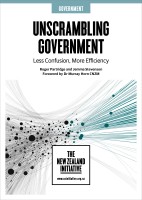
Roger Partridge talked to Sean Plunket on The Platform about The New Zealand Initiative's report proposing consolidating New Zealand's fragmented public service structure. Partridge outlined a three-step plan to streamline government by reducing ministerial portfolios from 81 to 15-20, creating junior minister roles, and consolidating departments from 43 to around 20, similar to peer nations like Ireland and Norway. Read more
New Zealand has built one of the most complex executive governments in the developed world. With 81 ministerial portfolios spread across 28 ministers and 43 departments, we operate with more than three times as many ministerial portfolios and nearly twice as many departments as peer nations like Ireland, Norway and Singapore. Read more
Roger Partridge talked to Wallace Chapman on RNZ's "The Panel" about his report "Unscrambling Government" which calls for reducing New Zealand's 81 ministerial portfolios to improve government efficiency. He argued that New Zealand's fragmented structure, with three times as many portfolios as comparable countries like Norway, creates accountability issues and inefficient decision-making compared to more streamlined international models. Read more
In this episode, Oliver talks to Roger Partridge about his new report "Unscrambling Government," which proposes consolidating New Zealand's extraordinarily complex government structure from 81 ministerial portfolios, 28 ministers, and 43 departments down to a more manageable 15-20 portfolios with corresponding departmental consolidation. They discuss how New Zealand's fragmented ministerial system creates accountability problems, increases fiscal costs, and hampers effective decision-making on critical issues like housing affordability, comparing unfavourably to other small advanced economies that operate with far simpler structures. Read more
Nick Mills discussed The New Zealand Initiative's report on government reform with Rt Hon Chris Hipkins on Newstalk ZB, focusing on our recommendations to reduce the number of government departments and ministerial portfolios. The Leader of the Opposition expressed sympathy for the Initiative's main point about convoluted relationships between departments and ministers, acknowledging merit in their research despite often disagreeing with their reports, and indicated he would consider such restructuring if Labour wins the next election. Read more
Dr Michael Johnston talked to Michael Laws on The Platform about grade inflation at New Zealand universities, explaining how A-grade rates have increased from 22% to 35% since 2006 and pass rates now exceed 90%. Dr Johnston argued that this trend stems from universities' commercial focus on retaining students for fee income, creating pressure to pass students regardless of assignment quality. Read more
New Zealand has one of the most complex systems of executive government in the developed world. With 81 ministerial portfolios, 28 ministers and 43 departments, we have three times as many portfolios and nearly twice as many departments as comparable countries. Read more