When sacred cows become too holy to slaughter
Every country has sacred cows: government programmes beyond criticism even when failing. Britain has the NHS, Australia has Medicare. Read more
Dr Eric Crampton talked to Corin Dann on RNZ's Morning Report about Labour's proposed NZ Future Fund, alongside Simplicity co-founder Sam Stubbs. Dr Crampton raised concerns about the fund's restrictions on asset sales and questioned whether it would create economic fragility rather than resilience, arguing that the $800 million in diverted dividends would need to be replaced through spending cuts or tax increases. Read more
Dr Oliver Hartwich talked to Sean Plunket on The Platform about Labour's Future Fund proposal, explaining how it differs from New Zealand First's similarly named policy and noting it lacks detail on funding and operations. Dr Hartwich highlighted contradictions between the fund's dual mandate, compared it unfavourably to Singapore's Temasek Fund, and identified protecting state assets from privatisation as the real political purpose behind the proposal. Read more
There’s a very old saying that taxation is the science of plucking the chicken without making it squawk. The earliest form of the saying seems to go back to a 1766 letter from French economist Anne Robert Jacques Turgot to David Hume – though the exact origins are disputed. Read more
New Zealand has an awful lot of odd little cartels. At least if we define ‘cartels’ using an economist’s definition rather than a lawyer’s definition. Read more
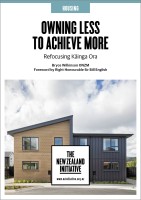
Kerre Woodham discussed our report "Owning Less to Achieve More" on Newstalk ZB, which advocates for housing vouchers instead of state-owned housing. Woodham endorsed the report's findings that government housing vouchers would empower vulnerable tenants by giving them choice in landlords, whilst highlighting the report's criticism of Kāinga Ora's high maintenance costs and inefficient management. Read more
I must confess, I am something of a literary philistine. So, when I heard this week that László Krasznahorkai had won the Nobel Prize for Literature, I had no idea who he was. Read more
In this episode, Oliver talks to Bryce Wilkinson about his new report examining Kāinga Ora, New Zealand's largest social housing provider, which manages around 78,000 units housing 200,000 people at a cost of roughly $2 billion annually to taxpayers. Bryce argues that the government could better support vulnerable New Zealanders by transitioning away from direct housing provision towards voucher schemes and other market-based alternatives that give tenants more choice whilst reducing costs. Read more
My stat of the week is 38 percent. This is the provisional voter turnout at the 2025 local elections. Read more
ou do not have to own someone's house to help them, so why does Kāinga Ora's Reset Plan envisage continuing to own around 78,000 housing units? This week, The New Zealand Initiative published my report "Owning less to achieve more: Refocusing Kāinga Ora". Read more
Mike Hosking discussedour new report on Newstalk ZB with Rt Hon Sir Bill English, who contributed the foreword to the report, which finds that Kāinga Ora's 77,000 homes cost taxpayers twice as much as the private sector and advocates for greater tenant choice of landlord. Sir Bill, who previously led the independent review of Kāinga Ora, explained that smaller-scale housing providers of around 5,000 homes demonstrate better economies of scale and tenant outcomes than Kāinga Ora's centralised model. Read more
Why does the government need to continue owning or managing more than 77,000 housing units, given its poor track record in this area, especially when state assistance can be provided without extensive government ownership? And why does it not release more land for housing? Read more
Wellington (Thursday, 16 October 2025) - Why does the government need to continue owning or managing more than 77,000 housing units, given its poor track record in this area, especially when state assistance can be provided without extensive government ownership? And why does it not release more land for housing? Read more
You do not have to own someone's house to help them, so why does Kāinga Ora's Reset Plan envisage that it will continue to own around 78,000 housing units? After all, social housing can be owned by any combination of central and local government agencies, housing associations, community housing providers, iwi providers, not-for-profit charitable organisations and for-profit landlords. Read more
This webinar launches "Owning Less to Achieve More: Refocusing Kāinga Ora", a report by Dr Bryce Wilkinson arguing that government should fund people, not property. Hosted by Dr Oliver Hartwich and featuring the Rt Hon Sir Bill English (former Prime Minister; chair of the 2024 Independent Review of Kāinga Ora), the discussion explores how separating funding from ownership through voucher-style support, releasing under-utilised land, and diversifying providers could lift housing outcomes, restore fiscal sustainability, and empower tenants—drawing on OECD practice and New Zealand’s social investment approach. Read more