Prescription for Prosperity 2026: Briefing to the Incoming Government
This is The New Zealand Initiative’s 2026 Prescription for Prosperity. Since 2017, the Initiative has prepared a briefing for the incoming government. Read more
You searched Publications for "" and got 68 results
This is The New Zealand Initiative’s 2026 Prescription for Prosperity. Since 2017, the Initiative has prepared a briefing for the incoming government. Read more
In August 2025, Dr Oliver Hartwich delivered the inaugural Da Vinci Lecture at the Portfolio Construction Forum Strategies Summit, an essay called Leonardo’s Legacy. That lecture attempted something ambitious – to trace the civilisational architecture that connected the Renaissance humanists to our present moment, and to explain how that structure was failing us. Read more
A grades are now only a few years away from becoming the most common grade awarded at New Zealand universities. The research note, ‘Fifty Shades of Grades: Grade Compression at New Zealand Universities’, builds on the Initiative's August report, ‘Amazing Grades’, which identified a substantial rise in A grades as well as rising pass rates. Read more
Nearly half of all grades at the University of Auckland were As during COVID-19, part of a dramatic rise in top marks that cannot be explained by academic improvement. Amazing Grades: Grade Inflation at New Zealand Universities, is the first analysis of grading patterns across all eight New Zealand universities. Read more
1. INTRODUCTION AND SUMMARY 1.1 This submission on the Education and Training Amendment Bill (No. 2) is made by The New Zealand Initiative (the Initiative), a Wellington-based think tank supported primarily by major New Zealand businesses. Read more
Nearly twice as many New Zealand school leavers fall into unemployment compared to those who undertake workplace-based learning, according to a new report released today by The New Zealand Initiative. While 11% of 16-19-year-olds are not in employment, education or training, just 6% participate in workplace-based learning. Read more
This research report provides a detailed and thoroughly documented examination of the state of academic freedom at our universities, together with an analysis of the main threats to academic freedom in this country at present. “We’ve collected 72 testimonies from academics, analysed 5 surveys of academics and students, and written up detailed reports on 21 incidents involving academic freedom that have occurred over the past decade in this country,” explained Dr James Kierstead, Research Fellow at the Initiative and author of the report. Read more
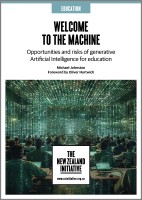
This report calls for a science-based approach to using artificial intelligence (AI) in classrooms. This will help schools get the most out of AI while reducing risks to teaching and learning. Welcome to the Machine: Opportunities and Risks of Generative Artificial Intelligence for Education, written by Senior Fellow Dr Michael Johnston, will help educators and policymakers navigate the rapidly evolving landscape of AI in education. Read more
This new research note, When the Bloat Began: Non-Academic Staffing at New Zealand Universities over the Long Run, 1961-1997, reveals the year in which non-academic employees started to outnumber academics at our universities. Building on the findings of our earlier research report, Blessing or Bloat? Read more