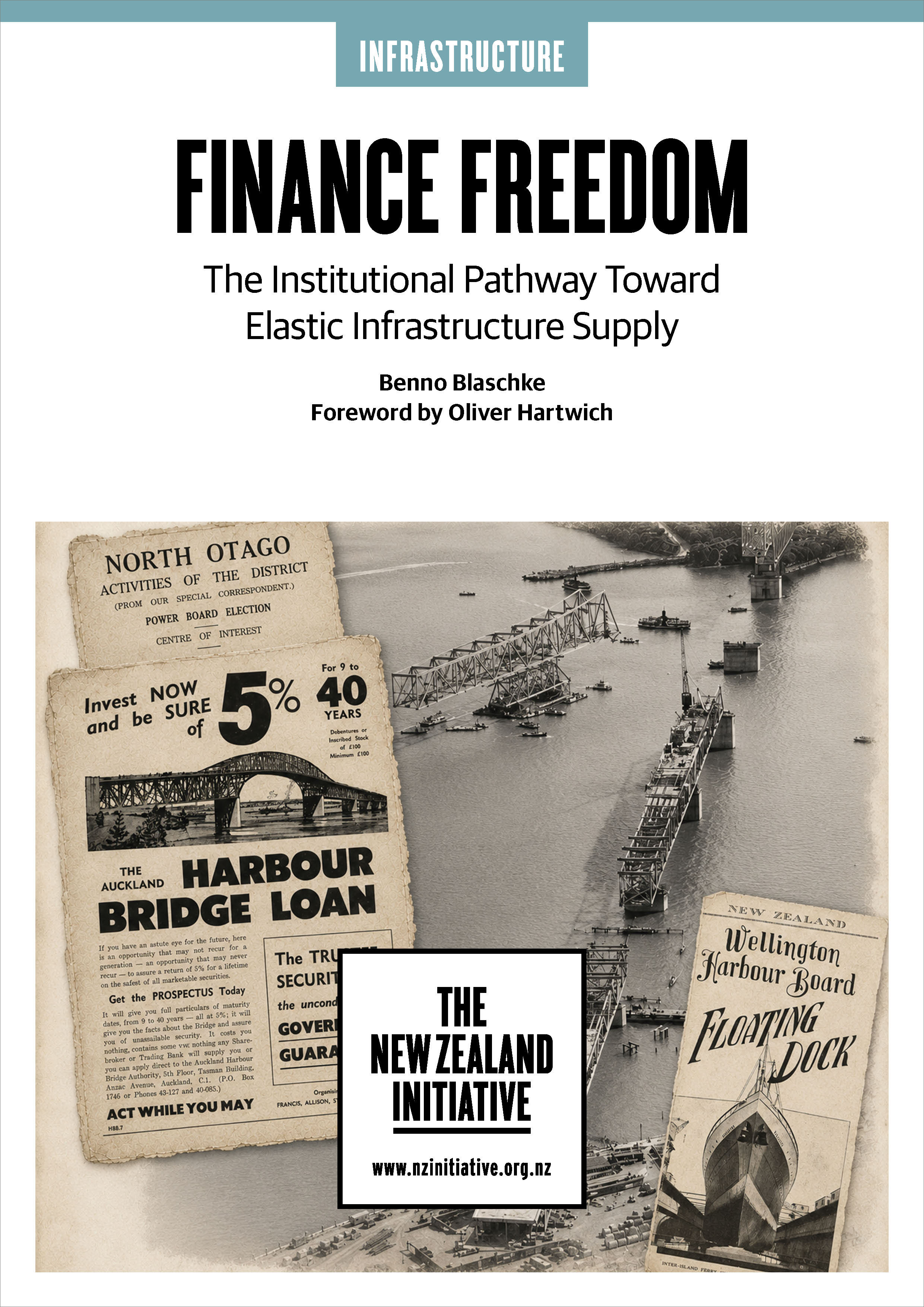


New Zealand cannot build enough houses because councils cannot afford the pipes and roads that new suburbs need. That is the conclusion of a new report by The New Zealand Initiative.
In Finance Freedom, Research Fellow Dr Benno Blaschke explains how council finances drive the housing crisis and how to fix it.
“When a council approaches its debt limit, it says no to growth,” says Dr Blaschke. “It uses planning rules to block development it cannot afford to service. Land becomes scarce, prices rise and a generation is priced out of home ownership.”
New Zealand spends more on infrastructure than almost any other developed country, relative to the size of its economy. Yet the Infrastructure Commission ranks it among the least efficient. “We spend more and get less,” says Blaschke.
The report proposes a second way of paying for infrastructure, alongside council borrowing. Private investors put up the money for the pipes and roads of a new development. The future residents then repay them over decades through a charge on their properties.
If a project fails, the loss falls on the investors who chose to back it, not on ratepayers or taxpayers. Because investors, not governments, are backing the projects, future residents are free to decide for themselves when and how they raise debt to forward fund the pipes and roads they need.

“This is not a radical experiment. It is how New Zealand built itself,” says Blaschke. “For most of last century, communities could vote to tax themselves and build the harbours and power networks they needed. We dismantled that system in the 1990s and have spent three decades paying the price.”
Parliament created the legal foundation in 2020 with the Infrastructure Funding and Financing Act. But six years on, only three projects have used it.
The report continues one of the Initiative’s longest-running policy projects, which began with the 2013 report Free to Build.
As Executive Director Dr Oliver Hartwich writes in his foreword: “Thirteen years have passed between Free to Build and this report. If that sounds slow, it is roughly how long good ideas take to travel from the fringes of debate to the statute books.”
The Initiative’s work on infrastructure finance spans more than a decade:
- 2013: Free to Build proposes Texas-style infrastructure districts for New Zealand.
- 2015: The Productivity Commission examines the model in its inquiry into land for housing.
- 2018: The Milldale development north of Auckland becomes the first project financed this way.
- 2020: The Infrastructure Funding and Financing Act writes the model into law.
- 2024: The Government establishes National Infrastructure Funding and Financing Ltd.
- 2026: Finance Freedom sets out the pathway to a fully working second finance channel.
Dr Benno Blaschke discusses his research report with our Executive Director Dr Oliver Hartwich on our podcast. Listen below.