The story that did not count
In many countries, an educational study claiming a radical improvement in mathematics learning would receive considerable media attention. But not, it seems, in New Zealand. Read more
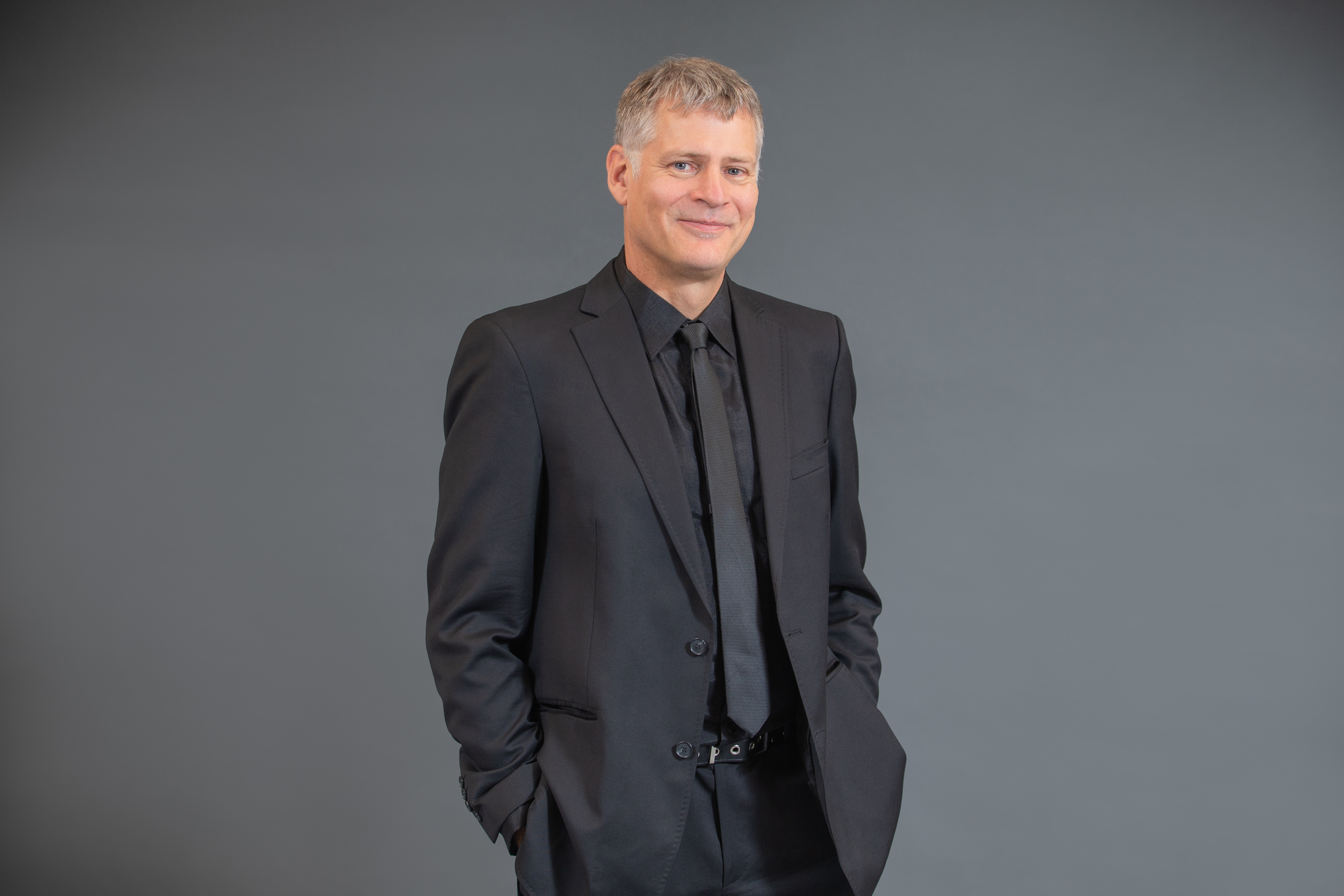
Michael is a Senior Fellow at The New Zealand Initiative. He leads the Initiative’s work on education. He is a cognitive psychologist with a background in literacy research, educational assessment and psychometrics.
Prior to his time at the Initiative, he was the Associate Dean (Academic) of the Faculty of Education at Victoria University of Wellington. Between 2005 and 2011, he worked at the New Zealand Qualifications Authority (NZQA), where he developed a new, more reliable, marking system for NCEA examinations. In 2024, Michael chaired a Ministerial Advisory Group (MAG) for Education Minister Erica Stanford. The MAG advised on the development of a knowledge-rich curriculum for English and mathematics. Following that work, Michael is currently a member of the Curriculum Coherence group, which advises on the development of knowledge-rich curricula across all school subjects. Michael is also a member of a technical advisory group to NZQA on assessment for NCEA and New Zealand Scholarship.
In his time at The New Zealand Initiative, Michael has published reports on Modern Learning Environments, systems reform in education, teacher education, the use of AI in education, and pathways for industry training and apprenticeships.
Phone: 044990790
In many countries, an educational study claiming a radical improvement in mathematics learning would receive considerable media attention. But not, it seems, in New Zealand. Read more
Dr Michael Johnston talked to Sean Plunket on The Platform about cultural relativism and debates over knowledge systems in New Zealand universities. Dr Johnston responded to accusations from Dr Anne Salmond that the Initiative and Free Speech Union are trying to dictate university policy, defending their support for open debate and the Education and Training Amendment Bill. Read more
Science embraces uncertainty. Scientists formulate theories to explain natural phenomena based on the available evidence. Read more
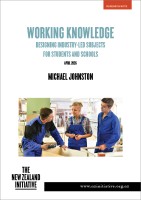
When NCEA was introduced in 2002, one of its goals was to improve the uptake and reputation of educational pathways leading to trades and industry. It was assumed that assessing vocational skills for NCEA alongside subjects like mathematics and history would help to accomplish this. Read more
In this episode, Michael talks to Sir Ian Taylor, founder of Animation Research, about what schools should prioritise in a rapidly changing world. The conversation explores whether traditional literacy still matters when machines can read, and whether curiosity-driven learning or knowledge-rich curricula better equip students for critical thinking in an unpredictable future. Read more
The population of South Korea is about 51 million. In a hundred years, it will likely be about 11 million – a reduction of about 80%. Read more
Earlier this week, teachers’ unions accused Minister of Education Erica Stanford of a “blatant power grab.” This followed Stanford’s announcement that the Teaching Council will no longer set professional standards for teacher training. The Ministry of Education will take over this responsibility. Read more
Dr Michael Johnston talked to Sharon Brettkelly on RNZ's The Detail about his role in the Curriculum Coherence Group and the public reaction to the draft curriculum refresh. Dr Johnston addressed criticisms of the knowledge-rich approach, defended the balance of New Zealand and international content, and argued that a knowledge-rich curriculum would help address equity gaps in education outcomes. Read more
AI chatbot Claude is a friendly chap. Knowledgeable and helpful, too. Read more
In this episode, Michael talks with Sir Nick Gibb, who served as England’s Minister for Schools for a decade, about the evidence-based reforms that transformed English education through systematic phonics, a knowledge-rich curriculum, and structured maths teaching. They explore how progressive education ideology led to England’s earlier decline in international rankings, the cognitive science underpinning effective teaching, and New Zealand’s promising early results from adopting similar reforms. To listen to our latest podcasts, please subscribe to The New Zealand Initiative podcast on iTunes, Spotify or The Podcast App. Read more
In this episode, Oliver talks to Michael Johnston about New Zealand's productivity paradox and why the country underperforms economically despite having strong institutions. They discuss lessons from small European countries like Switzerland, Ireland, Denmark, and the Netherlands, exploring how factors like decentralisation, foreign direct investment, trade integration, and national culture could help improve New Zealand's economic performance. Read more
Sometime in the first half of 2019, Ji Ruan, a senior lecturer in computer science at Auckland University of Technology, organised an event to commemorate the twentieth anniversary of the Tiananmen Square massacre. He no doubt assumed that, in a free country like New Zealand, this would be no problem. Read more
Vocational education has never had a good reputation in New Zealand. It has long been seen as a second-best option for ‘struggling students.’ University is the destination of choice for ‘good’ students, even if they have no idea what they want to do there. Read more
Dr Michael Johnston talked to Michael Laws on The Platform about grade inflation at New Zealand universities, explaining how A-grade rates have increased from 22% to 35% since 2006 and pass rates now exceed 90%. Dr Johnston argued that this trend stems from universities' commercial focus on retaining students for fee income, creating pressure to pass students regardless of assignment quality. Read more
At universities across the English-speaking world, grades have been going up. At US colleges, As (A+, A or A-) are now the most common grade. Read more