
Localism or centralism?
Last week, we applauded Housing Minister Chris Bishop for his housing policy proposals. Incentives for councils to promote growth perfectly match Prime Minister Christopher Luxon’s repeated calls for localism. Read more
Oliver is the Executive Director of The New Zealand Initiative. Before joining the Initiative, he was a Research Fellow at the Centre for Independent Studies in Sydney, the Chief Economist at the Policy Exchange in London, and an advisor in the UK House of Lords.
Oliver holds a master's degree in economics and business administration and a PhD in Law from Bochum University in Germany.
Oliver is available to comment on all of the Initiative’s research areas.
Phone: +64 4 499 0790
Last week, we applauded Housing Minister Chris Bishop for his housing policy proposals. Incentives for councils to promote growth perfectly match Prime Minister Christopher Luxon’s repeated calls for localism. Read more
Oliver and Matthew discuss NZ's infrastructure deficit, delivery and management which was the subject of Matthew's last column in the NZ Herald "Deficit obsession ignores abysmal state of Kiwi infrastructure delivery". To listen to our latest podcasts, please subscribe to The New Zealand Initiative podcast on iTunes, Spotify or The Podcast App. Read more
All eyes are on Europe as the Russian onslaught continues, Ukraine runs out of ammunition, and America’s upcoming election induces paralysis. Will the continent stand up to the challenge? Read more
Housing policy made significant progress this week. The housing minister, Chris Bishop, addressed the Wellington Chamber of Commerce and released a cabinet paper outlining his plan for solving the housing crisis. Read more
Non-academic staff outnumber academic staff in NZ universities. Recently, we found the point in time when this happened. Read more
When universities appoint vice-chancellors, they do not just pick a chief executive. They choose their academic leaders, who understand the value of research, teaching, and engagement with the public. Read more
Last week, Oliver and Roger sat down to talk about the Supreme Court's decision on the Mike Smith climate change case. To listen to our latest podcasts, please subscribe to The New Zealand Initiative podcast on iTunes, Spotify or The Podcast App. Read more
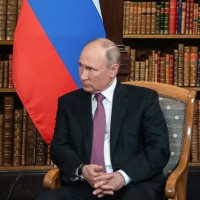
Tucker Carlson’s visit to Moscow made headlines in recent weeks. Carlson first did a servile interview with Putin, then produced a series of short videos expressing his admiration for Moscow, its underground and even supermarket shopping carts. Read more
Michael Laws talks to Dr Oliver Hartwich on The Platform about the implications of climate change litigation for New Zealand. Watch below
Read more
Never lead the Titans to revolt against the Olympian gods. It can cause a bit of back pain. Read more
Oliver talks to Professor Francis Greene from the University of Edinburgh Business School about entrepreneurship. They have a fascinating conversation about entrepreneurship as an idea, as a function and as a part of economics. Read more
The World Justice Project ranks New Zealand 7th out of 142 countries on its ‘Rule of Law Index’, narrowly ahead of Australia’s 13th place. However, Australia still has hope – if only because of a recent decision by the Supreme Court of New Zealand. Read more
The Revolution’s catch-cry of ‘Liberty, equality, fraternity’ is still France’s motto. It seems, however, that ‘equality’ doesn’t get you very far in Paris. Read more
In this episode, Oliver had a unique discussion with marine scientist Dr Regina Eisert via Starlink en route from Antarctica to NZ. They talk about Regina's experience in Antarctica as well as biological and research links between NZ and Antarctica, NZ research funding and who gets to go to Scott Base, NZ's Antarctic research station. Read more
In a previous column I discussed the precarious state of European security in light of the rising threat of Russia and the potential decline of US involvement (Europe’s precarious security could invite Putin to expand war, 26 January 2024). Today, I will analyse a potential way for Europe to organise its own security: the development of a European nuclear shield. Read more